To get from Caishikou Station to the Baoguo Temple, the first important thing is to find the correct direction. First identify the large Guang An Men Road which is the main traffic artery running east-west through Xuanwu District and which runs right past the Caisikou Station.
You should find that Luomashi Street leads eastward from the Station and Guang An Men Inner Street (as for; inside the former Gate and opposed to Outer Street outside the former Gate) leads westward to the horizon.
Next step is to simply follow the wide Guang An Men Road until finding the next big intersection as far as one block walking away.
The next intersection has Niu Jie, the Ox Street leading southward away from Guang An Men Inner Road and past the Ox Street Mosque and its main gate facing West.
- An Introduction -
This page was last updated: June 7, 2017
- Mouse over Image -
- Click to Enlarge -
- Click to Enlarge -
- Mouse over Image -
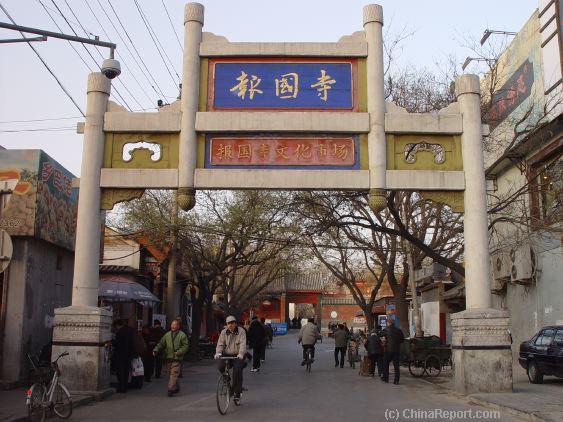
The marble Archway designating the Hutong with Bao Guo Temple Gate at end of Alley. Lower inscription : Bao Guo Temple Cultural Market (Photo: November 2004).
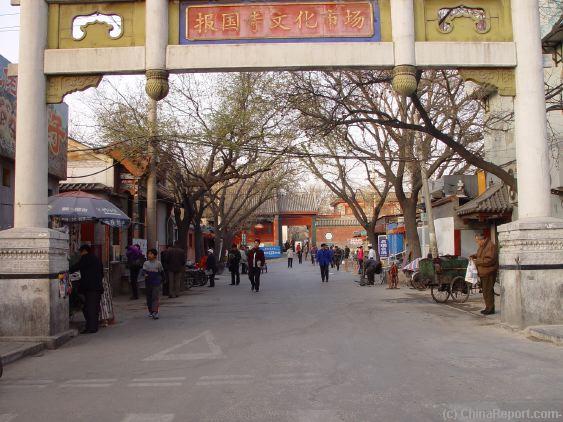
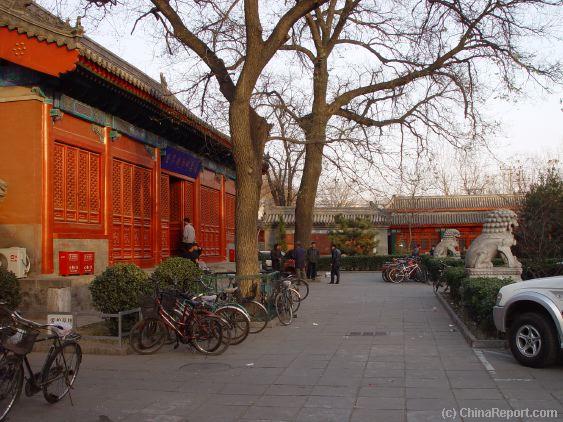
An easy athmosphere inside the Hutong or Alley. To the South are busstling main roads of Beijing ( Guang AnMen NeiDajie ) and Ox Street with its most well-known Mosque of Beijing ( and possibly China ).
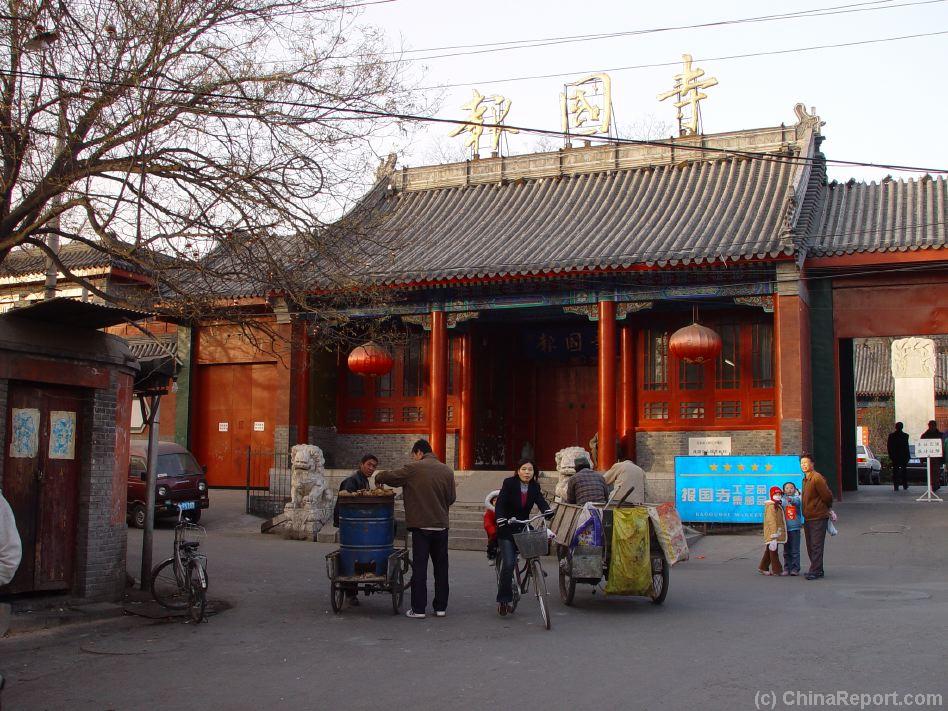
Buying Fresh and Hot Sweet Potato , a favorite Hutong Snack , in Front of Bao Guo Temple Gate. Here, Somewhat off the main boulevard the piece and quiet of the hutong return.
Inside The Temple Gate. Bao Guo Temple is small Temple only wellknown for its Cozy Temple Curiosa Market.
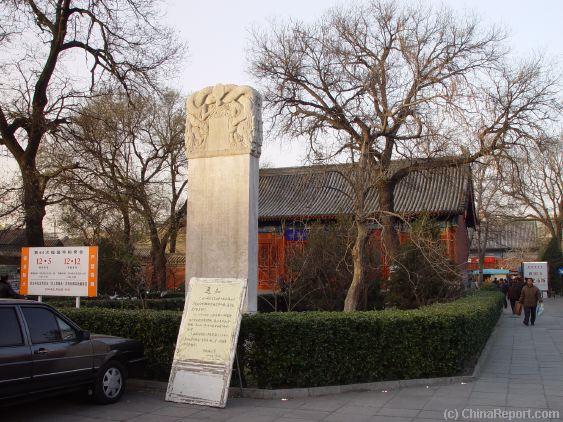
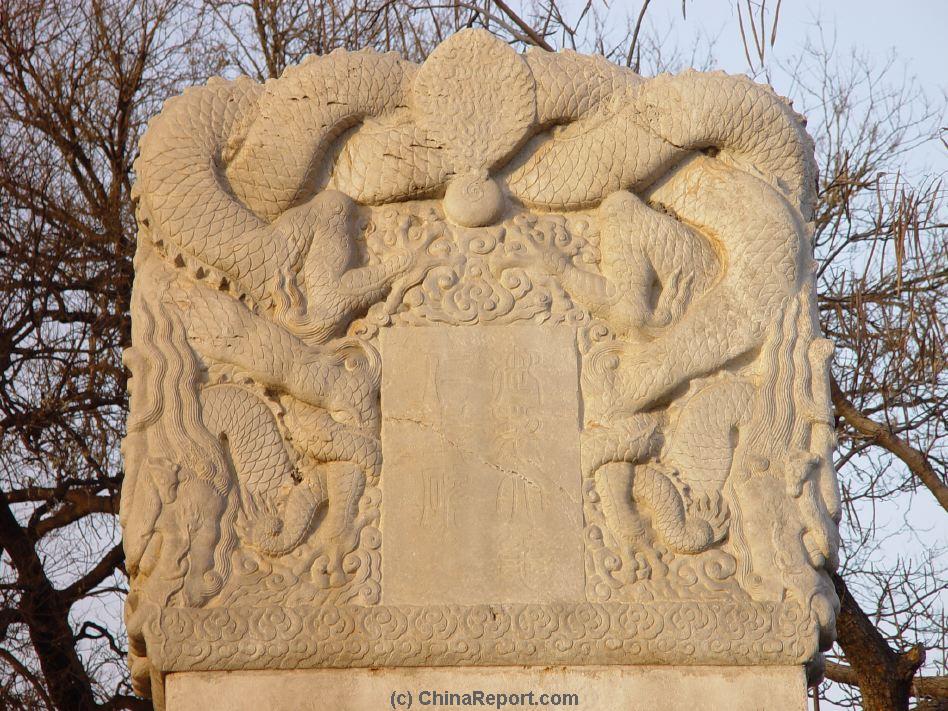
Traditional and Stone Carved Stele carried on the back of a Turtle , one of the Mythical Animals representing Longevity. Dated to the Ming Dynasty, 1466 AD.
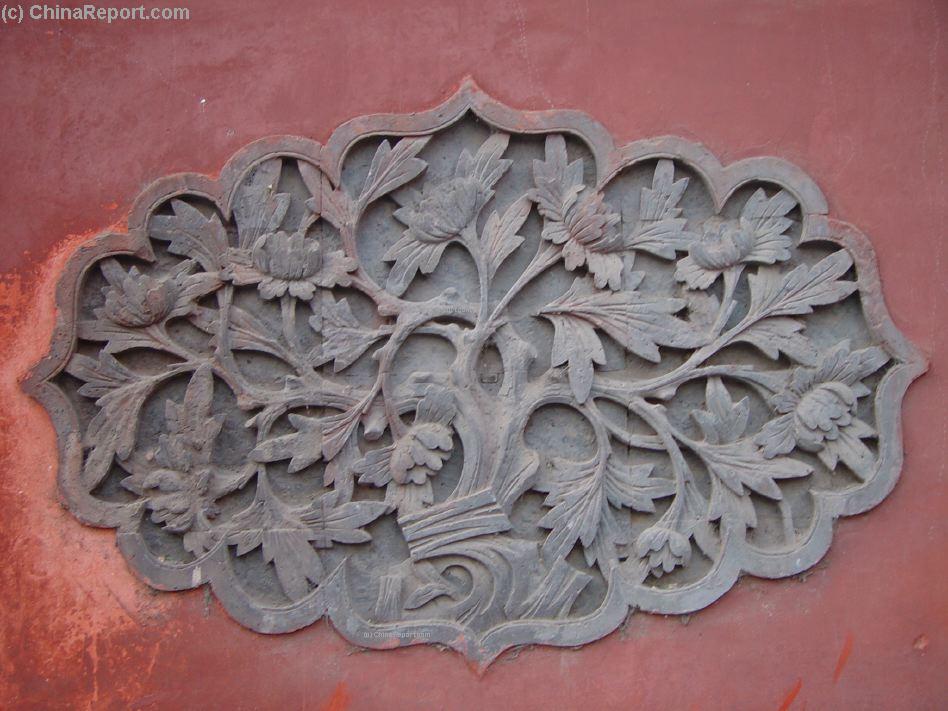
Very Nice Stone Carved Flowery Scrub , a decorative stone-carving found hidden in one of the Fair Grounds Corners.
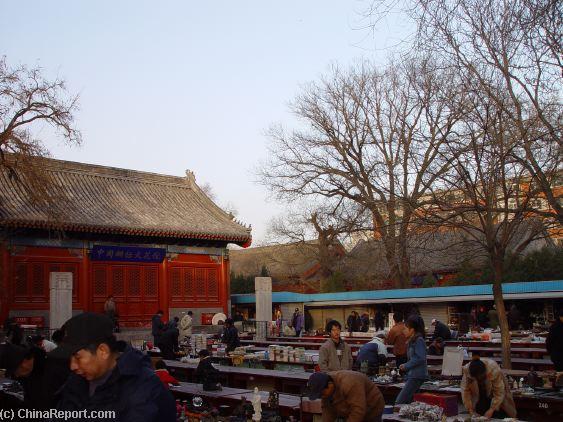
The regular Traditional Wooden Temple Main Prayer Hall, now in use as a Coin Fair & Trade. Many Chinese Coins and Stamps inside.
The Curiosa Market in the Temple Square closing up after a busy afternoon's trading. Although it has never been the most famous or richest curiosa market in Beijing, it certainly is one of coziest and calmest.
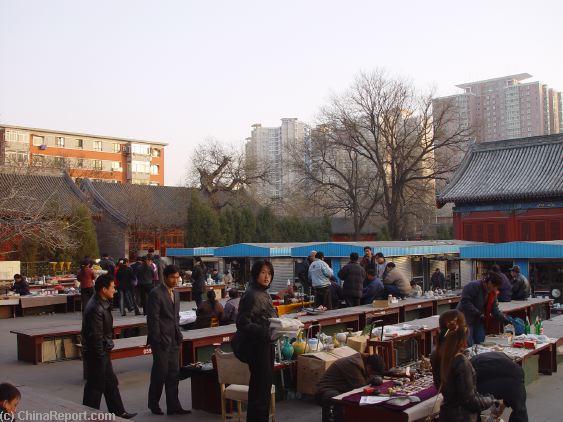
Bao Guo Temple Flea-Market in Beijing. In the Background the Tasteless drab highrises of Modern Xuanwu ( and Fengtai).
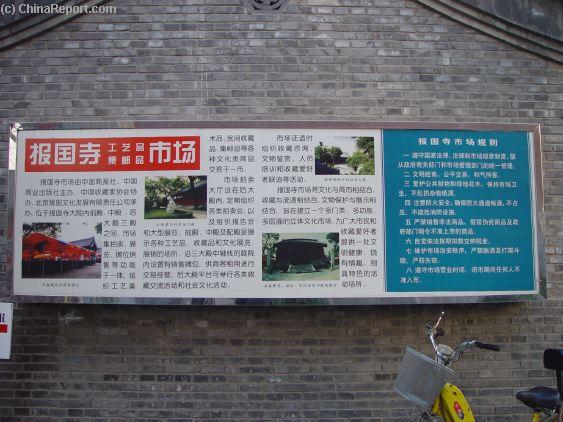
Read all about what's going on at Bao Guo Temple around the week and month. Unfortunatly, if you can't decipher Mandarin Chinese it does you no good, whatsoever. Its a coin, stamp and general market with History.
The Bao Guo Temple (广安门内报国寺) is one of those lesser out of the way temple structures that the city might have forgotten about, but did not in the end. Find the small but historic Temple also a collectors market at times, located just North off Guang'An Men Dajie', near the small Kongzu Park inside a Hutong of the Xuanwu District.
Not much information is available on the small Temple and at first glance it seems a rather inoccuous place barely worth preserving among the seeming multitudes of left-over Palaces and estates found in the better parts of the former Imperial City.
The Bao Guo Temple is not listed in any issue of Lonely Planet, nor any other guide book to the City of Beijing we have come across so far. And in fact its exact location is not even clearly marked by name or function on the world wide available Google Maps. Nevertheless, for those know how to
History of Bao Guo Temple in Beijing:
As one may have already sensed from the above, regardless of its lack of mention in official tourguides to Beijing, Bao Guo Si, meaning Protecting the Country Temple or Recompense the Country Temple, is one of the many historical and famous Temples in Beijing.
Originally constructed 540 years ago, in 1466 AD, the second year of Chenghua Reign of the early Ming Dynasty it has a longstanding history and a direct connection with the history of the Silk and Trade Road to Beijing. Still inside the Temple, some distance inside the Main Gate stands a white marble stele carried on the back of a tortoise. The Stele stands as a monument of the of the temple founding in 1466 AD.
Bao Guo Temple - How to Get There:
Previously, there was a lengthy description posted here necessary to follow in order to get to the neighborhood and actually discover the temple among the bustling noise of the city. However, mostly since the coming of the 2008 Olympic Games to the city of Beijing, a lot has changed. The most significant change for tourists and travelers visiting the city is a massive upgrading of the cities public transport system, opening up a whole series of new subway stations. As a result, finding the Baoguo Temple has become a lot easier.
MODES OF TRANSPORT:
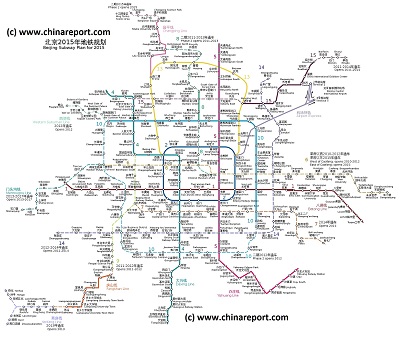
Travel via the the subway/metro system will provide the easiest mode of transportation, easily bringing one within a blocks distance walking from the location of the Temple. The nearest subway/metro station is Caishikou which is also the nearest station to the Fayuan Si Source of the Law Temple, the Ox Street Mosque and some other minor worthwhile sites hidden
Just for historic interest it may be noted that in the not so far past, at least until as late the year 1937 AD, the main boulevard of Guang'An Men Inner Street leading up to the former south western city gate, was an important road regularly navigated by Camel Caravans arriving into the City through Western Chang I Men (now demolished), heading for Islamic Traders located in this special area of the Xuanwu District, then known as the LiuHe Islamic Village.
Naturally, the nearby Mosque would be an important stop-over point for all arriving Muslim Travelers, after which they might finally have some rest from their rough travels and find some leisure in the nearby Hutong. Just a 100 meters to the East of here leads ChangChun Dajie', winding North and somewhat East, and to the South leads Ox Street, the traditional center of culture, religion and commerce in the old Liuhe Village.
Although the neighborhood remained seemingly frozen in time for many centuries and decades, today everything as changed. Formerly at the heart of its own Hutong Communities, the Ox Street Mosque and Baoguo Temple now mostly stand alone in between of a sea of Highrises and apartment blocks. The old inspiring neighborly feeling has gone away, except for a few remaining nooks and crannies
During the early years of the Manchu domination period, a period of National humiliation usually referred to as the Qing Dynasty (1644 AD - 1368 AD) Era the entire city thrived on the trade with the well to do living in the Inner City of the Capital. With the coming of the new Manchu Rulers however, one thing had notably changed. No longer, as was the case during the preceding Ming Dynasty (1368 AD - 1644 AD), were the Chinese Han the top class within society and therefor the Capital city. During the new Manchu Qing Era, the ruling elite once more lived quite apart from the ordinary people, however in this case the rulers were also of a very different ethnicity, lifestyle and culture. Seeking to preserve their heritage, culture and pure (and blessed) genetic purity, the Manchu mostly chose to shun contact with the Chinese as much as was possible.
As such, in the new arrangement of the city the Manchu People lived within the Ming Era City Walls of the Capital (today Xicheng and Dongcheng Districts) whereas the
Originally named Da Baoguo Ciren Si (Si=Temple) upon its founding in 1466 AD, the structures were later renamed as Gu Tinglin Temple.
Many centuries later in 1843 AD, during the reign of Emperor Daoguang of the Qing Dynasty, the poets He Shaoji and Zhang Mu were instrumental in collecting funds to convert the house in the Temple into a memorial to Gu Yanwu.
In 1922 AD, during the Republican Era and in a warlord dominated city of Beijing heroic Revolutionaries and political thinkers naturally held much more sway than under the ailing Qing Dynasty and thus the Temple and its history became the focal point of quite some popular attention. Seen as a proper place to worship for progressives who wished to rid themselves of the legacies of the Feudal Past, Bao Guo Temple received an influx of both visitors and funds.
Extensive renovations were done on the Temple, which was by then again known as Bao Guo Si, and the commemorative inscriptions of one Xu Shichang (1855 AD -1939 AD), a
- Mouse over Image -
As a Free Thinker Gu Yanwu put himself in considerable danger, which later turned out to be quite literally over his head. After his death by Suicide (on Feb. 15, 1682, Quwo, Shaanxi province), many celebrities attended services and ceremonies held at Bao Guo Temple. It was at this time that the Baoguo Temple was first established as a shrine to those who held alternative views about society as a whole.
Among his famous works titles as Notes on the Daily Accumulation of Knowledge and The Strategic Economic Advantages of Districts and States of the Empire. Even today he is still memorialized at the west-wing of his Former Residence here. In addition, services are held each spring and autumn to commemorate the Scholar and a special service is held on Gu Yanwu's birthday, July the 15th.
Other Former Residences of Celebrities nearby are Yang Jiaoshan Temple, a shrine after the Death of its former inhabitant Yang Jiaoshan, a famous minister in Jiajing regime of the Ming Dynasty. He was dismissed
from his office for writing a “Proposal on Stopping the Horse Market”. After resisting larger powers he was finally forced to commit suicide but interestingly sometime afterwards his righteousness and integrity was praised and worshipped by famous officials and scholars. As such he became a political icon and symbol in use for many hundreds of years, until this very day.
Or find Shaoxing Guild Hall, the first Beijing Home of great modern literature, ideologist, and revolutionary writer Lu Xun at No. 7 Nan Banjie Hutong, west of XuanwuMen (Wai), now a officially museum but not to be confused with the official Lu Xun Museum found far up north
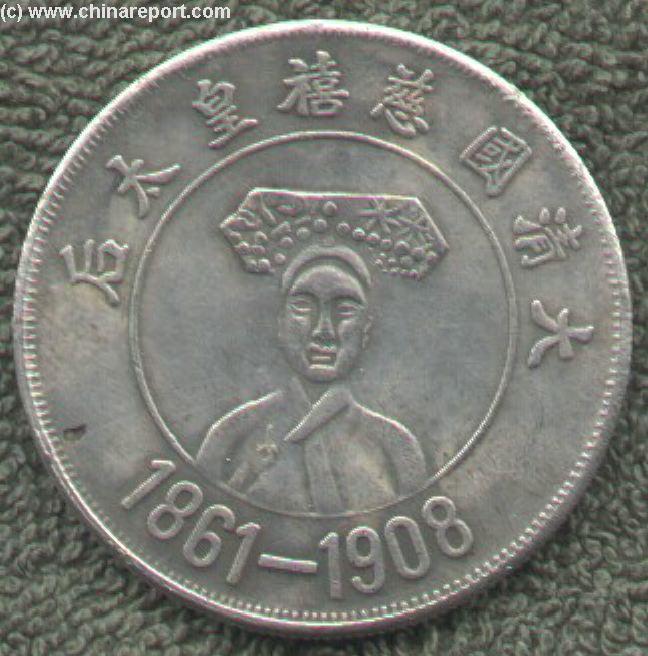
An example of some of the coins traded at Bao Guo Temple, a silver dollar from the years of Empress-Dowager Cixi at the end of the Qing Dynasty. It is still in reasonable shape.
During the first few years of the new millennium Baoguo Market was still mostly undiscovered by the crowds, and considered far inferior to the much hailed Panjiayuan market in the south of Chaoyang District, it never thrived to become loved by the masses. In those years it was still the domain of the genuine collector as well as the old hutong grandpa trying to make a living and fill up his meager pension. Those days have now gone and professional sellers now occupy the market.
Not too many true antiques or valuable goods an be found at Baoguo Market today, however for coin collectors and other hobbyists it is still a well appreciated niche market to come check on. For everyone else, it is chance to browse the left overs of popular Chinese Culture. The market is among things renowned for its old picture books and cartoons.
In the western courtyard of Bao Guo Temple, away from the crowds of the
Dwell around the market enjoying a browse for curiosa, or better yet, find a fine specimen somewhere among the traded coins or stamps. If not in the mood for such, have a look at around the Hutong, stroll down south to Ox Street and its Mosque or move on to FaYuan Si, the source of the Law Temple - which sits hidden between hutong nearby. As mentioned there are some Celebrity Homes dotting the area too.
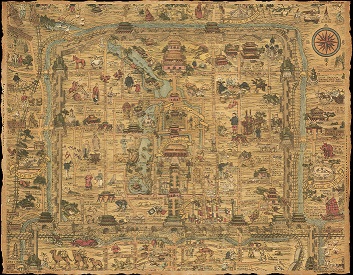
Schematic Map of the the Walled City of Beijing in the year 1936 AD produced for tourist purposes and as souvenir. The Map highlights the various Palaces, Main Temples and other monuments of interest within the city, as well various other spots of historic or commercial interest. Apart from a number of minor Temples and the still famous Hong Qiao thieves market
CLICK MAP IMAGE TO GO TO FULL VERSION !!
Having fallen into disrepair after the long period of China's self elected seclusion from the outside world, culminating in the near complete destruction of all old cultural aspects and traits during the so called ”Cultural Revolution Era” (1966 - 1976) the Baoguo Temple was mostly forgotten as late as at the turn into the new millennium when it was still the most insignificant Temple and Temple market in all of West Central Beijing. Although the locals knew it, and were rediscovering the economic benefits of its ancient Temple Market, most of the old stories about the Temple had been lost and forgotten.
As a result of it all, not too much information can be found about the earliest centuries of the Temple, however by contrast - much of the significance of the Temple in the political and religious life of the city of Beijing during the previous century can still be gathered.
What little is known among the general populace is described in brief below.
president in the Northern Warlord government that held an instabile (and corrupt) control over what now amounted to a City State, were imprinted on a wall inside. The imprinted Letters had been damaged and nearly faded into history, however today they have been restored and can be viewed on site as one of the few historical treasures refering to this dark period in the history of the city. As part of the extensive renovations of the Xuanwu District and the Minority Village of Beijing, the Beijing municipal government has undertaken repairs on the Baoguo Temple in the year 2002 AD. In the process the Temple was designated a key Cultural Protected Site under Government Protection by the City of Beijing.
Most recently, the entire temple has been once more restored and repainted as part of the city wide efforts in preparation for the year 2008 Olympic Games.
Bao Guo Temple and Temple Market in Beijing today:
at No. 19 Gongmenkou Ertia Road (Gongmenkou Third Alley) .
Although Lu Xun was a native of south western China, after becoming a modernist and finding education in Japan he spent a considerable time living in Beijing and wrote some remarkable short stories there. Coming to prominence only in 1918 AD, through his first ever written and published short story, originally, he lived in what amounted to rather a poor man's house in this neighborhood and one wonders if he ever visited the
Baoguo Market and for what purpose that might have been. It is this area where the diabolical and still hauntingly relevant short story ”Diary of a Mad Man” came into being and was a hit among the people who considered themselves to be part of the so called New Cultural Movement. One of the stories that most vividly brings to life his experience of being on the streets of being is the story titled ”Hair”. As with all Lu Xun short stories, it is a rather gloomy tail describing - among things - the experience of a rickshaw drive during a windy and wintery morning.
daily market some additional history is hidden. The fact is not very well advertised, not even inside the BaoGuo Si and its grounds, but it so happens that the Temple Grounds, specifically the west wing, once served as the home of Gu Yanwu a noteworthy person living in the last corrupt decades of the Ming Dynasty Era (1368 AD - 1644 AD) and the years of the succeeding Qing Dynasty.
Gu Yanwu, by career a scholar, was a native of Kunshan, near the famous scenic city of Suzhou on the Grand Canal in current day Jiangsu Province. Born in the year 1613 AD and by the time of his coming of age Familiar with national classics, county stories, astronomy, instruments, farmers and soldiers, he was a traditional Confucian Ming Dynasty scholar by heart. However, confronted by the nations take over by the hostile Manchu peoples from north of the Great Wall, Gu never served the court as advisor but instead elected to boycott the Dynasty and devote his life to his studies and teaching, much as Confucius himself had done over almost 20 centuries earlier.
Thus becoming a famous and popular scholar during the early years of the succeeding Manchu Qing Dynasty, Gu Yanwu became a famous author writing numerous articles which were then reprinted and read widely. Being a Philosopher, among things, he advocated the “integration of learning and application”- and new principles for things such as “learning from the text”, “think before acting”. Although this may seem like nothing even noteworthy today, at the time, he and other mentors represented a whole new way, a revolutionary way of thinking in a society. Reading these ideas and agreeing with them seemed a like saying that one was ready to break away from the strong feudal traditions of the past. As with Lu Xun and many New Youth Movement writers and proponents centuries later, his writings agitated not so much against a Dynasty but against a way of thinking. But what for Lu Xun and his companions was difficult, was impossible in the times of Gu Yanwu. In fact, for centuries onwards arguing against the Emperor meant a guaranteed death sentence. However, arguing against the Dynastic and Feudal system was considered practically unthinkable to most - thus an even graver offense, at least by the conservative and established elements of society.
In his days, Gu Yanwu agitated against and participated in the struggle against the newly arisen, alien and non-native Han Qing Dynasty, the kind of activity that eventually always led to problems.
As a local Temple the Bao Guo Temple only serves a minor function, however as a Temple Market this location regularly brings in the crowds from all over the surrounding neighborhood. In addition, although not so much notable for its modest architecture, the Temple is a historic location which could be considered a shrine to political dissidentry, in its various shapes of the bygone era's.
Though large scale tourist movers and agencies will not notify potential visitors, altogether both Temple and surrounding neighborhood form an interesting area to spend time in and get acquainted with.
away in that particular area of the Xuanwu District of the Central City.
Another alternative of course is to ask a Taxi to take one directly to the Temple Gate. In this case, it would be wise to bring a map along in order to make sure the driver understood your intentions correctly.
Taking Taxi's cabs probably will not improve on speed or comfort. In addition of course there is the higher fee and the missing out on all that stands surrounding your destination.
As for travel by bus, this would be a lengthy and complicated process which is also usually not too comfortable. Dismiss the thought. Most modern Beijingers have already agreed as the subway system is now becoming over crowded with those finding their social life's in various hotspots around the city. It is the easiest and most care free mode of getting about.
The Baoguo Temple is especially easy to find and navigate to when coming from the Caishikou Subway Station. The first leg of the hike to Baoguo Temple even corresponds with the most direct route to the popular Niu Jie (Ox Street) Mosque which stands at minimal walking distance from the more reclusive and hidden Baoguo Temple. Initial directions are similar.
Full Map of the Beijing Subway System of 2015 AD
- Click Map for FULL Version ! -
To find Baoguo Temple, one must not turn southward, but go across the intersection and follow Guang An Men Inner Street further westward.
For the last steps, keep to the northern side of Guang An Men Inner Road until coming in view of the Pailou Welcome Gate saying BaoGuo Temple and a narrow alley leading up to its external (south) gate. As such, you have arrived at your destination.
To be sure, the Baoguo Temple cannot be missed between the modern day buildings that have arisen near the Caishikou and Niu Jie intersections. The only thing separating the Temple for wide and busy Guang An Men Inner Street is a short hutong alley. About a 100 meters up the Hutong from a white marble and painted PaiLou, one of the few such remaining within the City. which is the only object clearly identifying the location as seen from down on the boulevard.
AsiaReport.com generated Google Map Overview of the location of Baoguo Temple just north off Guan An Men Inner Street in the Xuanwu District of Beijing.
and yes - the Ox Street Mosque and Baoguo Temple have been commercialized as tourist venue's.
Find out more about the latest developments below.
lower classes were all expected to live outside of the city walls where they could do less harm in case of an uprising. There they were also more exposed to military attacks, plus had to contend with lesser accomodations, less space and above all sub standard drinking water taken from the brackish wells in the southern districts.
Socially, it was all quite interruptive, especially for the Han who now found themselves in the humiliating position of living below some of the other lower classes, wheras Mongolians and Tibetans - fellow Buddhists and more importantly peoples with a nomadic tradition were increasingly trusted and relied on to fill important and powerful Government positions.
Since the Han had been bumped down to social ladder to become the lower stratum, all of them living within the city were deported outside of the walls by Imperial Decree (Read more in: History of Beijing (2) Beijing during the Qing Dynasty).
As a result of the social changes, the former Elite of the Empire and those whom they associated with were all forced to set up anew in the southern districts, at which time the LiuHe Islamic Village and the Caishikou Area became the place of residency of quite a few renowned scholars, writers, artists and the like. At first, commerce, which was already strong in this particular part of the city filled with exotic people and traders, blossomed on the capitals of the Han with their peculiar and often still expensive tastes. Among things, they were interested in art, gold, jewelry, silks but also had peculiar hobbies and were in need of books to provide for their scholarly needs. Thriving on the culture brought in by the more educated Han book stores, antique stores and curiosa markets started appearing. As time passed and things progressed, the Caishikou Area became especially popular among those received from the various cities and towns in the Provinces of the Empire, seeking to pass the highest level of the Imperial Exams and become (in)famous ”Jinshi” (Read more in: Confucius Temple of Beijing).
Rising on this new wave of culture at some point in time new markets and shops appeared creating a beginning of what today is known as the Baoguo Temple market.
Noteably, although now over-commercialised and still nearly forgotten as a historic relic, the Baoguo market was thus created earlier in history than the now famous Liu Lichang Culture Street found more to the north and west.
As it is remembered today, during the length of the Qing Dynasty until its fall in the year 1911 AD, a well-visited Temple Fair was held at Bao Guo Temple each month, according to the Lunar Calendar. Later during the Qing Dynasty Bao Guo Temple and Market were the place where flowers were traded. The Flowers were brought in from the then still undeveloped area's and hutong gardens of the surrounding Xuanwu District, where they were grown in large quantities. At that time nearby Ox Street was a wide street along which orchards and flower gardens abounded.
Still later during the Qing Dynasty, the first antique books market in the history of Beijing was opened at Bao Guo Temple, which was considerably earlier than the Antique Shops at Liulichang street, now famous as the antiques street in the City of Beijing. Not much of the original structures remain however.